
Federal Budget 2026/2027 Review
Treasurer Jim Chalmers last night handed down the Federal Budget, widely considered one of the most controversial Budgets in recent memory.
Significant tax reform has been proposed; with the government’s primary goal being to improve housing affordability for young people - the effectiveness of these measures remains to be seen.
At a high level, asset holders will lose some tax concessions, with workers set to receive minor tax benefits. These amendments will be staggered over various timelines.
Headline Items
Permanent instant asset write off
Carried forward loss provisions
Capital Gains Tax
Discount removed
Cost base indexation introduced
Minimum tax rates
Pre-CGT assets taxable
Negative gearing prerequisites
Minimum trust tax rates
Instant asset write-off
Permanent $20,000 instant asset write-off.
Businesses with turnover less than $10m will be eligible to instantly write off assets capped at $20,000.
Carried-forward loss provisions
Losses refundable
From 1 July 2026, company tax losses incurred in an income year can be carried back to offset taxable income in either of the preceding two years.
To be eligible, a business must have annual turnover of less than $1b in the income year.
This provision has been reintroduced whereby businesses will be able to offset current-year losses against tax paid in the prior two financial years. This will be a refundable amount, limited by the company's franking account balance.
Capital Gains Tax
50% CGT discount removed, Cost base indexation introduced, 30% minimum tax rate introduced, Pre-CGT assets taxable
The Budget proposes significant reform to the Capital Gains Tax (CGT) regime.
The 50% CGT discount, available where a CGT asset is held for at least 12 months, is set to be replaced by a cost base indexation method, together with the introduction of a new 30% minimum tax on net capital gains. Furthermore, previously "pre-CGT" assets will also fall into the CGT net.
These measures are proposed to apply from 1 July 2027.
CGT assets disposed before 30 June 2027 will still receive the 50% CGT discount if qualified. Assets acquired before 1 July 2027 and sold after are expected to require apportionment between the discount and indexation method on gains accrued pre and post 1 July 2027.
Investors have the option to sell formerly pre-CGT assets before 1 July 2027 and crystallise the exempt gain, or obtain a market valuation of the asset as at 1 July 2027, which will form the cost base of the asset for future CGT purposes.
Negative gearing
Negative gearing limitation – Residential properties
From 1 July 2027, investors will no longer be able to offset rental losses against their personal income for residential properties purchased from 12 May 2026.
There are exceptions to the above with respect to new residential builds.
Disallowed deductions will be carried forward and offset against future property income including capital gains, behaving similarly to carried-forward tax losses.
Properties purchased prior to 12 May 2026 will be exempt from these changes, with properties acquired between 12 May 2026 and 1 July 2027 able to be negatively geared until 1 July 2027, but not thereafter.
Note that residential properties held in superfunds are not affected.
Trust distribution tax
Minimum tax rate for trusts · No tax credit for corporate beneficiaries, potentially resulting in double taxation
A minimum tax of 30% on discretionary trust distributions will apply to distributions made after 1 July 2028. The tax will be collected and remitted by the trustee and will generate a non-refundable tax credit in the hands of the beneficiary. Corporate beneficiaries will not receive this non-refundable tax credit, which may result in double taxation.
The introduction of the trust tax has essentially eliminated the benefit where a beneficiary's marginal tax rate is below 30%.
Some trust structures are exempt from this, including fixed trusts and deceased estates.
Some income types are also exempt, including primary production income.
There will be a proposed "roll-over relief period" of 3 years from 1 July 2027, to allow groups to restructure. The mechanics of this are yet to be communicated.
The comparison below shows the difference between the current and proposed trust tax rules. It is unclear if trust distributions are to be grossed up to include the non-refundable tax offset available to non-corporate beneficiaries.
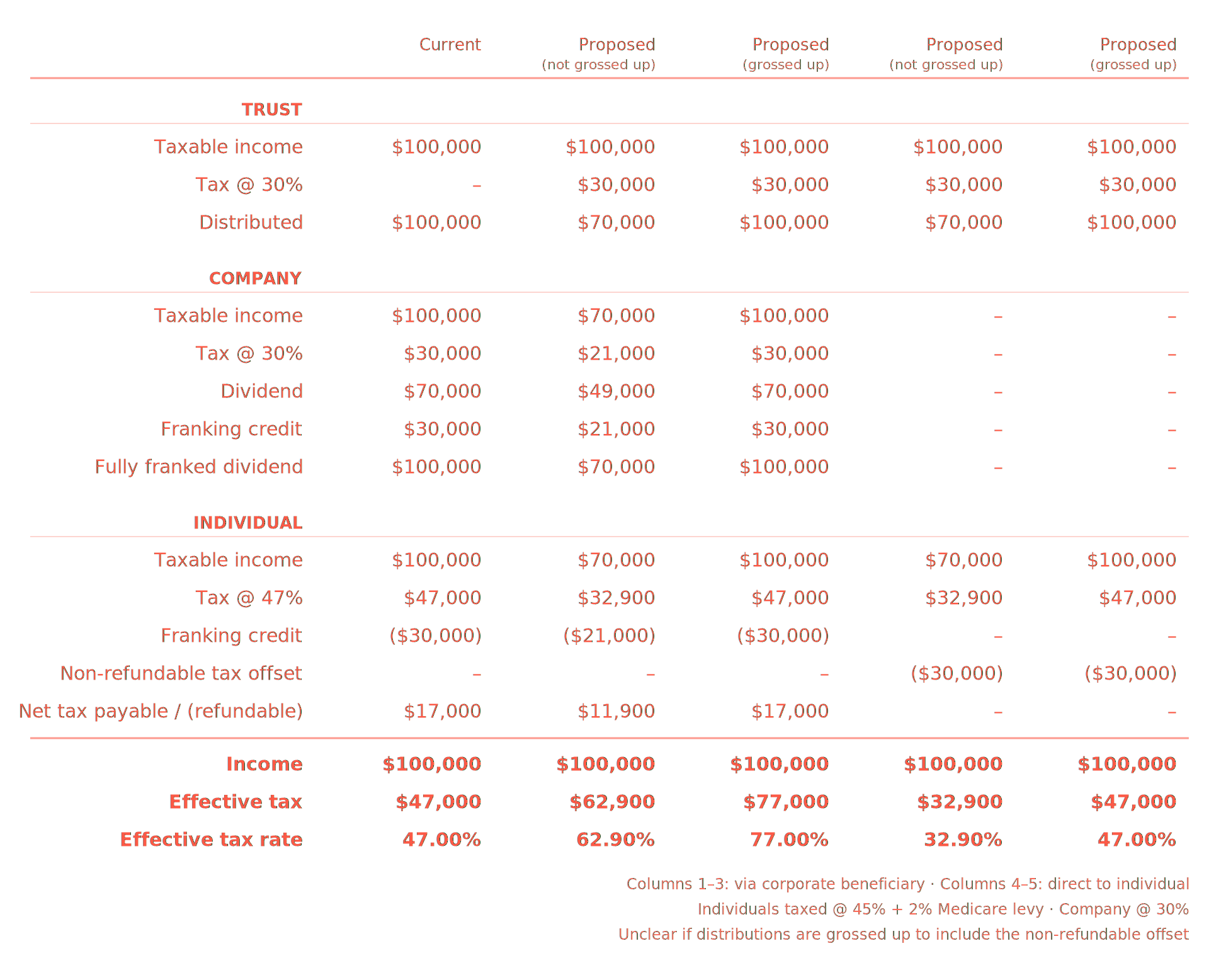
Figure 1.1 — Current vs proposed trust tax outcomes
Key Takeaway
On face value, it appears beneficial to bypass a corporate beneficiary.
There is still a significant amount of detail to be released in relation to the practical application of these measures, but one thing is clear: this will alter the way businesses and investors operate in the future.
Please feel free to get in touch with any questions.